Wednesday, 18 April 2012

Elizabeth Taylor death


 Elizabeth Taylor  

Elizabeth Taylor, who died today at age 79, didn't dwell on death—as she used to say, she'd already been there, done that.

"I'm a survivor," she once said, "a living example of what people can go through and survive."
Was she ever.


Nine Lives
In the beginning, in the 1940s, Taylor was a child star of uncommon beauty who won hearts in Lassie Come Home and National Velvet. In her prime, in the 1950s and 1960s, she was an A-list star who commanded the screen opposite Paul Newman (Cat on Hot Tin Roof), James Dean and Rock Hudson (Giant), and drew Hollywood's first $1 million payday. In later years, she was a bawdy, grand dame who didn't shirk her past, or make excuses for her excesses.

"When I was 15, I told  L.B. Mayer to go to hell," Taylor said in The Advocate in 1996. "It was then that I realized I was a complete, free individual and that I loved God…And I felt free."
True to her spirit, if not her sense of the dramatic, Taylor was the first actor to be pronounced dead—and go on to win two Academy Awards.
No, the great Elizabeth—she detested her media nickname, Liz—didn't do anything small.
"The more, the better, has always been my motto," she said in 1994.

Beginnings


Born Elizabeth Rosamond Taylor on Feb. 27, 1932, in London to American parents, the girl for whom the phrase "violet-eyed beauty" would become synonymous arrived in Hollywood in 1939 as her family fled war-torn Europe. A neighbor secured Taylor a screen test with Universal Pictures. She was put under contract, and at age 10, debuted in the 1942 comedy, There's One Born Every Minute.
If Taylor's screen presence was evident early on, Universal didn't see it—the studio cut her loose. And so it was MGM that would secure the services of the future icon.

Her first feature for Mayer's star factory was the Technicolor canine classic, 1943's Lassie Come Home, costarring Roddy McDowall, a fellow child actor who became one of Taylor's fiercest real-life friends.
Her next major role, in 1944's National Velvet, proved her breakthrough—and her medical downfall.
During filming of the equestrian drama, the 12-year-old Taylor took a spill from a horse. The resulting back injury proved chronic—the first in a terribly long list of ailments, which included: an emergency tracheotomy (a byproduct of near-fatal double pneumonia) (1961); severe respiratory problems (1990); double hip replacement surgery (1995); an irregular heartbeat (1996); a benign brain tumor (1997); a broken back (1998); a second broken back (1999); pneumonia (2000); skin cancer (2002); a broken foot (2003); heart surgery (2009); and congestive heart failure dating back to the early 2000s. The health troubles helped fuel dependencies on alcohol and painkillers, which landed the legend twice in rehab, in 1983 and 1988.
During the double pneumonia spell, which resulted in Taylor being administered last rites, the actress said she "actually saw the light."

"When I came to, there were about 11 people in the room. I'd been gone for about five minutes—they had given me up for dead and put my death notice on the wall," Taylor told The Advocate.
Taylor's habit of holing up in the hospital was rivaled only by her habit of walking down the aisle.
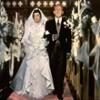

Elizabeth Taylor, Father of the BrideElizabeth Taylor, National VelvetElizabeth TaylorElizabeth Taylor, Roddy McDowell, Lassie

Marriages and Divorces
In what's now known as corporate synergy, but then was just good old-fashioned publicity, MGM launched production of Father of the Bride in tandem with the announcement that Taylor, at age 17, was engaged to one William Pawley Jr.

The Taylor-Pawley nuptials were never to be, superceded by the Taylor-Hilton nuptials. Hilton was Nicholas Conrad Hilton Jr., the hotel scion and future great uncle of Paris and namesake Nicky Hilton. He was also the first ex-Mr. Taylor.

The Taylor-Hilton union endured less than nine months, with reports of Hilton's alleged abusiveness to surface years later.

A divorcee at not-quite 19, Taylor became a mother at not-quite 21, with the birth of a son to her second husband, actor Michael Wilding.

The Taylor-Wilding union produced one more son before ending in 1957.
Proving that the 1950s must have been more a tad more permissive than public-health films of the era let on, the moviegoing public never disowned its "violet-eyed beauty," even if by mid-decade, she was a two-time divorcee. Taylor, in fact, enjoyed her greatest cinematic run, highlighted by four successive Oscar nominations, from 1958-1961, as she embarked on her third and fourth marriages.

In 1957, the 24-year-old Taylor wed producer/impresario Mike Todd. The marriage produced a daughter, born prematurely in August 1957, but lasted only 13 months. The culprit wasn't divorce; it was a plane crash that claimed Todd's life. (As noted by People, Taylor's own passing came nearly 53 years to the day of the March 22, 1958, accident.)

Following Todd's death, public sympathy for Taylor was at an all-time high.


In 1958, Fisher was a chart-topping singer, a TV star, and a picture-perfect husband to girl-next-door Debbie Reynolds. Fisher and Reynolds were good friends of Todd and Taylor. When Todd died, Fisher lent Taylor a hand. And then some.
"The thought of having a love affair with Elizabeth never entered my mind. Never," Fisher wrote in his autobiography. "But at about 4 a.m. [one] night…she called me. I don't remember much of our conversation, except she said emphatically,  unsecured loans 'When you get back, we have to talk. I want to see you.' I assumed she wanted to talk about Mike. Which demonstrates how little I understand women."
And thus commenced the Taylor-Fisher affair, which begat the Reynolds-Fisher divorce, which, in 1959, begat the Taylor-Fisher marriage.
While the scandal cooled the career of Fisher, who died in 2010, it helped his new bride score a groundbreaking movie deal.

In October 1959, Taylor, notorious as a home-wrecking sexpot, agreed to star as the empire-wrecking sexpot of Cleopatra for $1 million, the first time any Hollywood star—male or female—hit the seven-figure mark.

In the beginning, Taylor's salary amounted to one-half of Cleopatra's budget. In the end, it didn't amount to one-fortieth.

Cleopatra was, in two words, a mess. The production schedule was plundered by bad weather. Sets were built, taken down and rebuilt. A director quit. Costars bailed. The script never quite got done. Pneumonia nearly killed the leading lady.

By April 1961, Taylor, at least, was back bad credit loans on track, having risen from her deathbed to accept her Oscar, her first, for the call-girl drama Butterfield 8. (Remarked Shirley MacLaine, nominated that year for The Apartment: "I thought I might win...until Elizabeth Taylor had her tracheotomy.")

Meanwhile, back at Cleopatra: Richard Burton, then in-demand as the star of Broadway's Camelot, was brought in to play Marc Antony, Taylor's onscreen lover. In time, he became Taylor's offscreen lover, too. And thus commenced the Taylor-Burton affair, which begat Burton's divorce from his wife, which begat Taylor's divorce from Fisher, which, in 1964, begat Taylor's marriage to Burton.
"What do you expect me to do?" Taylor asked once. "Sleep alone?"
Meanwhile, back at Cleopatra: The movie finally got made. It bowed in theaters in 1963, won four Oscars and grossed a then-strong $26 million. One problem: It cost its studio a then-staggering $44 million—the equivalent of a $300 million-plus production today.
What marriages, divorces and scandal could not do, Cleopatra did: The movie put a drag on Taylor's career.


Transitions
After Cleopatra, Taylor never again starred in anything approaching an epic or box-office blockbuster. In just her early 30s, she became the world's most famous character actress, taking on offbeat films, such as John Huston's Reflections of a Golden Eye, and rejecting glamour for dowdiness, as in Who's Afraid of Virginia Woolf?, for which she won her second Best Actress Oscar.
Taylor's new career was Burton. The star couple costarred in eight films, including Virginia Woolf, and one TV-movie. Most of the projects were bad or worse. With movies such as Boom! to their discredit, Taylor and Burton proved themselves the anti-Tracy and Hepburn.
At least the couple appeared to be enjoying themselves. They adopted a daughter in 1964, and stayed together long enough for Taylor to celebrate her first, and only, 10-year wedding anniversary. But not long after the milestone, the Taylor-Burton union ended. It was briefly revived for Taylor-Burton II, from 1975-76.

By the 1970s, Taylor's film career was all but over. During her 1976-82 marriage to U.S. Sen. John Warner, her seventh husband, Taylor's weight ballooned, and she became a comic target for the likes of John Belushi and Joan Rivers.
Eventually, the laughter died; Taylor lived on. She did stint on General Hospital, at the height of the soap's Luke-and-Laura popularity. She did Broadway, even reuniting there with Burton. In 1985, as friend Hudson was dying of AIDS, she led Hollywood efforts to battle the disease, cofounding the American Foundation for AIDS Research, and later, establishing the Elizabeth Taylor AIDS Foundation and the Elizabeth Taylor Endowment Fund. She launched her own line of perfume. She even got married—again.

During a 1988 rehab stay at the Betty Ford Center, Taylor met Larry Fortensky, a fellow patient and mullet-maned construction worker 20 years her junior. It was a match made for a paparazzi-pleasing 1991 wedding at Michael Jackson's Neverland Ranch. Said Taylor at the time: "I always said I would get married one more time and with God's blessings, this is it, forever."
Forever lasted about five years. Taylor and Fortensky separated in 1995, with the divorce finalized in 1997.
Burton, whom Taylor called, along with Todd, "one of the two great loves of my life," died in 1984, at age 58.
In later years, about the closest Taylor came to the altar was when she stood up for Liza Minnelli at the singer's own ill-fated 2002 wedding to producer David Gest. (Appropriately, Jackson was present for those nuptials, too.)
Taylor's last film appearance came in 1994's The Flintstones.


The Dame


If Taylor's career waned in the later years, then her early years were enough to ensure a wealth of career honors—from the American Film Institute, the Kennedy Center, the Motion Picture Academy, and even the Queen of England, who deigned Taylor a Dame of the British Empire in 2000.
In 2003, Taylor announced her retirement. Public appearances became rare. When she did venture out, she was often in a wheelchair. In 2006, Australian and U.K. tabs said Taylor was "at death's door." Her publicist labeled the reports false. A month later, the National Enquirer said Taylor was in the early stages of Alzheimer's disease. This time, Taylor herself labeled the report false.

"Oh, come on, do I look like I'm dying?" Taylor asked Larry King in 2006, her first TV interview in years. "Do I look like or sound like I have Alzheimer's?"

Ever the survivor, Taylor outlived the author of her New York Times obituary by nearly six years.
Though retired from Hollywood, Taylor refused to retire from her activist work. "There's still so much more to do," she told the Associated Press in 2005. "I can't sit back and be complacent, and none of us should be. I get around now in a wheelchair, but I get around."
Yes, Taylor did manage to get around.

As she herself once admitted: "My life has had so many ups and downs that sometimes it takes even my breath away."

Monday, 16 April 2012

Chelsee Healey to replace Alesha Dixon


After it was revealed that Alesha Dixon was jumping ship and would not be appearing on this year’s series of Strictly Come Dancing, bosses quickly started looking for a new star to fill the role.
The ‘Man Does Nothing’ hitmaker has defected from the BBC dance show, to the judging panel of ITV’s Britain’s Got Talent and will begin auditions for the new unsecured loans series later this month.
The Mirror reports that producers have already approached Chelsee Healey about taking Dixon’s seat at the judges’ table, after she shot to fame on the 2011 series of the show, finishing in second place behind Harry Judd last month.


“BBC bosses have a shortlist of about eight names and Chelsee is one of them. She would do really well with younger viewers and help bring in a new demographic.
“As a successful past contestant – like Alesha was – Chelsee will understand exactly what the celebs are going through and bring with her that empathy.”
However she does face some competition for the job and insiders admitted that also vying for a spot on the panel is former contestant Nancy Dell’Olio. Despite the fact that she was perhaps the worst dancer of the 2011 run and spent more time being flung around by bad credit loans her partner Anton DuBeke than actually dancing, the Italian beauty thinks she would be perfect for the role.

Nancy has her heart set on the role. She was one of the main reasons the last series had such fantastic ratings.
“She believes people stopped watching when she was booted off and thinks her sense of fun and unique personality are just what Strictly Come Dancing needs.”
Who do you think should replace Alesha this year? Many Unreality TV readers have already admitted that they would love to see Arlene Phillips returning to the show. Would you back that move? Leave your comments below.

One Direction

One Direction are in a spot of legal bother as a US band has filed a lawsuit, saying that they owned the name 'One Direction' first.

The pre-pubescent popstars, who are currently reducing teenage girls across America to tears, could be forced to pay out over £600,000 in damages to a US boyband, who also have five members.

The other One Direction formed in 2009 and also claim that they registered the name with US Patent and Trademark Office before The X Factor runners up even met.

Writing on their blog, the US One Direction attempted to soften the blow of the lawsuit by stating that they liked the British version of the band, but were going to sue them anyway.

They wrote: "To protect our rights, we reluctantly have filed a lawsuit. Despite our best efforts, unsecured loans we were unable to negotiate a reasonable compromise with the handlers for the band. They chose not to use a different name. They chose to press ahead, using the exact same name, One Direction, setting up the current difficulties and confusion in the United States.

The blog added: "The British boy band is well funded and high profile. They have Mr Cowell's enormous resources behind them. We on the other bad credit loans hand do not. In our view, we were here first. We have rights. We have talent, and we have heart. We are standing up for all of the above. Not having money does not take away your rights or make you 'less than'."

One Direction have not commented on the suit as yet.

Friday, 13 April 2012

Bubba Watson, the Anti-Tiger


bubba-watson-465.jpg
For followers of Bubba Watson, the gap wedge he hooked forty yards around trees and gallery and onto the green yesterday to secure his Masters victory wasn’t terribly surprising. Nor was the fact that twice on the eighteenth—once in regulation and again in the playoff—Bubba hit drives that left him throwing distance from the pin on a hole most of the field had to approach with long irons. Bubba’s power, and his shotmaking prowess, are by now as common to witness as Tiger Woods’s Sunday red. You see Bubba pull out the pastel driver (pink clubhead and shaft, his way of supporting breast cancer awareness) and punish the ball with an arrhythmic thwap, the recoil of which requires him to tap step his follow-through, and you know the ball he’s just hit is travelling some three hundred plus yards forward and fifty side-to-side.

It’s unorthodox, Bubba’s game, and until a couple of years ago it was unproven against the multitude of perfectly planed swings the Tiger era has produced—swings like Adam Scott’s and Justin Rose’s, two of the purest on tour, both honed under the direction of Butch Harmon and Sean Foley, respectively, Harmon being one of Tiger’s old coaches, and Foley his current one. Like Tiger, and seemingly most other players on tour, Scott and Rose are forever in lesson mode: fearful of crossing the line on their backswing, of getting stuck inside, of the left elbow being a smidge out of position on the takeaway, throwing the whole process into doubt. Bubba has no such concerns, though, because he’s never had a lesson and, to hear him tell it, never had a swing thought, either. He tees the ball up and smashes it as hard as he can—past everybody on tour, it should be noted—and then hunts it down and smashes it again. Often he finds himself in places not designed for the normal course of play, hence the need to have a forty-yard hook wedge in the bag. This week, though, it worked. Watson, after years of struggle on the P.G.A. Tour, finally broke through in 2010, when he finished in a tie for second at the P.G.A. championship. Now, after taking advantage of a course that favors big hitters, as my colleague John Cassidy predicted he might, Bubba is a major champion, and Rose and Scott, for all their technical perfection, could manage only top tens.

Watson grew up on the Gulf Coast not far from me, and occasionally I would have to compete against him in junior golf tournaments. He’s a few years my senior, so we didn’t face off often, but when he was in the field you knew about it. At the beginning of the tournament you’d hear of his feats the week prior—Bubba carved a three-metal around the clubhouse, landed it pin-high; Bubba drove it over the green on a three-hundred-and-seventy-yard par four; Bubba blasted one out over the lake, brought it back into play with a violent slice. You didn’t know what to believe. Then you would walk to the first tee well before your starting time, watch Bubba launch one, and realize that the rumors were all true. Or true enough. There was solace in the fact that he’d likely hit it deep in the trees, but by the end of the day he’d beaten you, and everyone else.
Autodidacts have all but disappeared from professional golf since 1997, when Tiger won Augusta by a million shots. That victory was proof that greatness on the golf course required constant monitoring and tutelage on the practice tee. Dissections of the unsecured loans for you golf swing, aided by increasingly advanced high-speed cameras, became commonplace. So did having a swing coach handy at all times to tell you, immediately after you sign your scorecard in Torrey Pines or Pinehurst or Winged Foot or Valhalla, why you overcooked that eight-iron on the fourth hole. (The club got half a click past parallel at the top.) But recently, with Rory McIlroy’s victory last year—McIlroy has a swing coach, but one whose approach is, by modern standards, hands-off—and now with Bubba taking the green jacket in overtime, the play-by-feel method which dominated the game for so long could be making a comeback.

It was hard to imagine, in the days of junior golf, that someone with a swing as non-conformist as Bubba’s could someday win a major. In many  bad credit loans ways Bubba was and is the anti-Tiger. He’s a lefty, he’s self-taught, and he’s emotional after the round, not just during it. Yesterday, before Watson could make it to Butler cabin to talk it over with Nantz and Faldo, he was met on the tenth green by some of his biggest fans who just happened to be fellow tour players. There were hugs, and some tears. And a hint, maybe, of a new way forward for golf, a way that feels a bit more natural.

Thursday, 29 March 2012

Britain’s Got Talent


THE Britain’s Got Talent judges gave the thumbs down to one would-be star when he turned up on stage dressed as a Roman soldier.

The 57-year-old retired HGV driver, who told the Britain’s Got Talent panel he was called Maximus, was the first act on stage at the Manchester audition and recited a scene from the hit Russell Crowe film Gladiator.
However, he did not impress Britain’s Got Talent supremo Simon Cowell who said it was a “horrible, horrible start” to the new series which begins tonight.

Other acts included a man playing a unsecured loans  harmonica with his nose and a roller-skating couple before student Sam Kelly arrived on stage with his guitar and brought the house down.

The 19-year-old from Norfolk told the Britain’s Got Talent panel he was “pretty much useless at everything but music” before silencing the crowd with his performance. Cowell told him: “When you’ve got absolute silence in a room like this you’ve nailed it.”

The stars of the Britain’s Got Talent show at the Birmingham audition were a coachload of 133 teenage boys from the South Wales valleys.

The choir, called Only Boys Aloud, brought Amanda Holden to tears.

There was another emotional performance from teenage bad credit loans duo Charlotte and Jonathan with Cowell telling the latter he was “a future star” and should strike out on his own.

Tuesday, 27 March 2012

Lara stone


We’re always overcome with excitement when a new issue of Love is due out, but a couple of images that have been unveiled from the unsecured loans next issue have us even more intrigued than usual. What we know is that the theme of Issue 7, due out February 6, is “After Taste” and Kate Moss, Lara Stone and Rachel Zoe, who has styled for the glossy before, are all involved. While the above Mario Testino-lensed image of our favorite bad credit loans European blonds Lara Stone and Kate Moss wearing floral and gold-embroidered cat ears (they’re credited as bunny ears on Love‘s site but that makes no sense) warms our hearts, we’re a little creeped out by how young Kate looks. At least compared to, say, this recent video for her Mango campaign. Just sayin’.

Monday, 26 March 2012

Hunger Games Exposed


  • "Hunger Games" depicts a futuristic, high-tech world where reality TV showcases teens fighting to the death.
  • Many futuristic technologies are depicted, but others -- like the Internet -- are not represented.
  • Such "gaps" in technology don't necessarily represent plot holes, according to historians of science and technology.

"Hunger Games" heroine Katniss Everdeen walks between two Capitol Peacekeepers who maintain control over the nation of Panem. Click to enlarge this image.
Lionsgate/Murray Close

Tomorrow's world of "The Hunger Games" doesn't just showcase the reality TV spectacle of teenagers battling to the death -- it also features futuristic hovercraft, force fields and bioengineered "Mutt" creatures.
Those technological marvels represent tools of oppression for the dystopian nation of Panem, where the Capitol elite live in high-tech luxury supported by the old-fashioned sweat of district coal miners, farm hands and factory workers.
But the popularity of the "Hunger Games" series has not stopped some fans from eying the technological imbalances of the story.
Some question why a post-apocalyptic North America filled with futuristic technologies would still rely upon coal for its electricity needs; others wonder about the unsecured loans story's complete absence of the Internet. One character in "The Hunger Games" books complains about "forgotten" military technologies such as high-flying planes, military satellites and robotic drones, even as he rides inside a hovercraft.
NEWS: Navy Opens 'Hunger Games' Arena for Military Robots
Such "gaps" in technology don't necessarily represent plot holes, according to historians of science and technology. Real societies have adopted or rejected technologies based on whether they suited their particular economic, political or cultural circumstances.
"Technology is not pre-determined as "better" -- it becomes better when a society deems it to be better or more advanced," said Joline Zepcevski, a researcher with a Ph.D. in the history of science and technology at the University of Minnesota. "With respect to "The Hunger Games," there is no reason why a new society, rising from the ashes of an old society, would necessarily re-invent the same technologies."
Technology has come and gone throughout history, said Marie Hicks, an assistant professor of history of technology at the Illinois Institute of Technology Chicago. Electric cars appeared on U.S. roads at the start of the 20th century, but disappeared for almost a century before making their recent comeback. Supersonic civilian jetliners made their debut with the Concorde in 1976, but ended up grounded in 2003.
Even high-speed trains that took off in Japan, China and Europe have mostly failed to catch on in the U.S. (the Capitol rulers of "The Hunger Games" still have a high-speed rail system).
Technologies of Terror
So why does Panem in "The Hunger Games" feature some technologies and not others? The Capitol rulers may be focused on technologies useful for social control, said Eden Medina, assistant professor of informatics at Indiana University.
For instance, the bioengineered "Mutt" creatures bad credit loans  become weapons of psychological terror in the Hunger Games -- an annual event that forces each of Panem's 12 districts to provide a boy and girl tribute for a televised gladiatorial battle.
NEWS: Terror Bots Being Designed to Hunt You Down
The Capitol also puts televisions in every home and big screens in public squares to broadcast the hateful Hunger Games and other state propaganda to the masses. That act echoes both George Orwell's dystopian "1984" story and real totalitarian societies such as North Korea (although North Korea relies more on radio).
By contrast, the Capitol rulers strictly limit phone communication between districts and don't have anything resembling the Internet. Their choice to avoid the Internet seems like a no-brainer, because its ability to give voice to the masses makes it much more difficult to control than television.
"It's hard to say because it's a fictional world and we'd have to ask Suzanne Collins (author of "The Hunger Games"), but it's not outside the realm of possibility that this society would make those decisions," Medina told InnovationNewsDaily. "I'd imagine it might be harder to keep news of a district uprising secret if there's many-to-many Internet communication."
Some Are More Equal Than Others
The technological imbalances within "The Hunger Games" also highlight the story's emphasis on social and political inequalities. The repressive Capitol enjoys instantly prepared food, smart household gadgets and obsessing over the latest Capitol couture, Medina points out. By contrast, the "District 12" home of heroine Katniss Everdeen located in today's Appalachia has a poor, starving population that works in the coal mines and suffers from electricity shortages.
"Uneven technological development is a staple of science fiction because it implies a society, and a government, that has lost its way or has mistaken priorities," Hicks said, "And as a result unjustly divides technological resources, or uses those resources to control the populace in inappropriate ways."


By drawing a contrast between the futuristic Capitol's wonders and the dangerous, dirty work of coal mining, "The Hunger Games" may be prompting readers to sense that "some underlying element of this society is in disorder," said Bernard Carlson, a professor of science, technology and society at the University of Virginia.
"If you're (the Capitol) producing energy to make the houses of elite comfortable, and they don't pay the environmental or safety price for it, you might as well use coal as opposed to something else," Carlson said.
In the end, "The Hunger Games" does not celebrate the progress of technology -- an idea that historians of science and technology see as overly simplistic anyway. Instead, the books show how a society's technological choices reflect its political motivations and social priorities.
Still, even the historians who have picked up "The Hunger Games" don't judge the story too seriously based on its technological choices. They, too, want to be entertained.